
7 Home Renovation Trends Austin Homeowners Are Choosing in 2026
Written by Roy Faust
Born and raised in Austin, Texas, I graduated from Lamar University with a Bachelor’s Degree in Marketing in 1999. In 2006, I started New Creations and I am most proud to say we have earned 170+ Five-Star Client Testimonials.
Home Renovation
7 Home Renovation Trends Austin Homeowners Are Choosing in 2026 Written by Roy FaustBorn and raised in Austin, Texas, I graduated from Lamar University with a Bachelor’s Degree in Marketing in 1999. In 2006, I started New Creations and I am most proud to say we have earned 170+ Five-Star Client Testimonials. Home Renovation Updated […]
Updated August 2026
Top renovation and remodeling requests in Austin, Texas
These are the home renovation trends Austin homeowners are choosing in 2026 — the kitchen, bathroom, and whole-home ideas we’re seeing most in our remodel projects this year. Renovation styles move slowly, but they do move. If you’re planning a project, here’s where homeowners are heading right now.
1. Warm Tones Replace Gray
The cool, all-gray palette that defined the 2010s is on its way out. In 2026, homeowners are moving toward warmer, earthier tones — soft whites, greige, clay, olive, terracotta, and natural wood grains. The appeal is emotional as much as visual: after years of screens and stark interiors, people want rooms that feel calm and grounded.
What this looks like in practice: warm white cabinetry instead of cool gray, wood-tone islands or open shelving, and natural materials like stone and unlacquered brass that develop character over time. In Austin specifically, these warmer palettes work with the region’s strong natural light rather than fighting it — a gray that looks sophisticated in a showroom can read cold and flat in a sun-filled Hill Country kitchen.
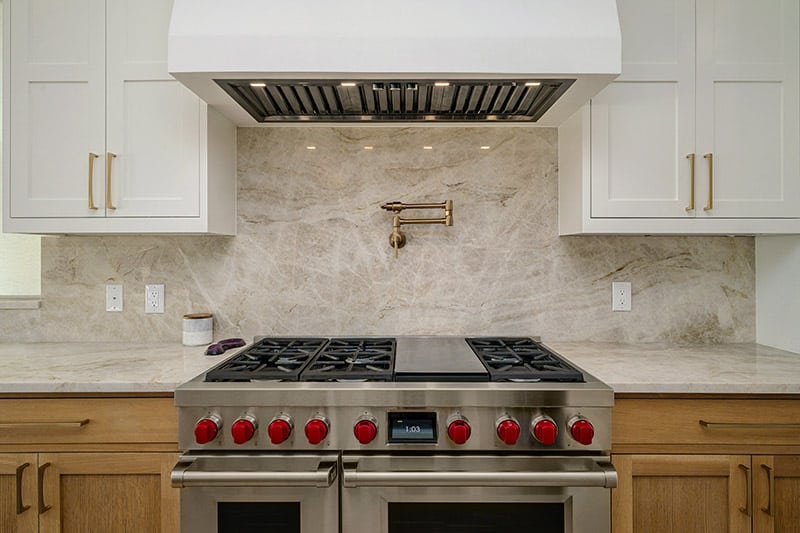
Use it wisely: warm neutrals are more timeless than any bold color, so they’re a safe foundation. Save the trend-driven choices for things that are easy to change later — paint, hardware, textiles — and keep the expensive, permanent elements (cabinets, counters, flooring) in tones you’ll still love in a decade.
2. Kitchen Trends 2026: Bigger Islands
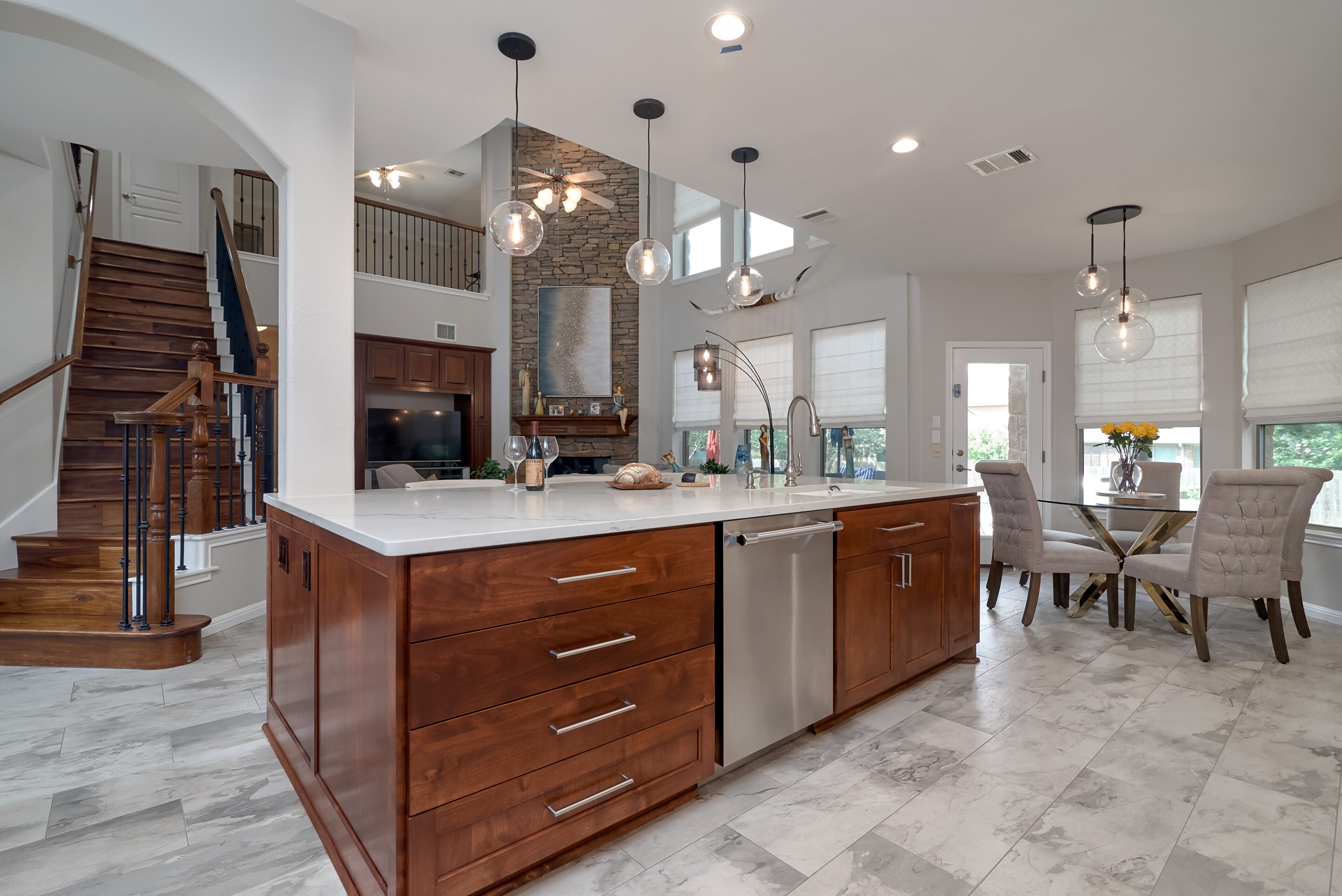
If there’s one anchor to 2026 kitchen trends, it’s the island. It has quietly become the most important element in the kitchen — the place where people cook, eat, work, and gather. Homeowners are asking for larger islands with comfortable seating for three or four, and increasingly a second prep sink or a dedicated zone so two people can work without colliding.
Alongside the island, two things are changing how kitchens look. Panel-ready and integrated appliances hide the refrigerator and dishwasher behind cabinetry for a seamless, furniture-like finish. And the “everything matches” rule is gone — mixed metals are in, most often warm brass or unlacquered gold paired with matte black. Done well, the mix reads as intentional and layered rather than mismatched.
Use it wisely: an island is only as good as the space around it. You need roughly 42–48 inches of clearance on every side for it to function, so a bigger island isn’t always better — the right size depends on your kitchen’s footprint. This is exactly the kind of decision where a design-first approach pays off, because the island has to be planned around traffic flow, not just dropped in.
3. Mixed Stone Surfaces
Quartz isn’t going anywhere — it’s durable, low-maintenance, and consistent. But 2026 is seeing natural stone return for statement moments: a marble or quartzite island, a soapstone perimeter, a dramatic waterfall edge. The trend isn’t one material winning; it’s mixing them on purpose.
A common 2026 approach is quartz on the hardest-working surfaces (the perimeter counters that take daily abuse) paired with a natural-stone island as the showpiece. You get the practicality where you need it and the beauty where you’ll see it most.
Use it wisely: natural stones vary enormously in how much care they need. Marble etches and stains; quartzite is far harder; soapstone patinas over time by design. The right choice depends less on the trend and more on how you actually use your kitchen and how much maintenance you’re willing to do. Ask to see how each material has held up in a real, lived-in kitchen before you commit.
4. Bathroom Trends: Spa Baths
The strongest bathroom remodel trend in 2026 is the spa bathroom — a primary bath designed to feel like a retreat rather than a utility room. The signature elements are curbless (zero-threshold) showers, freestanding soaking tubs, heated floors, and the “wet room” layout that places the tub and shower together in one glass-enclosed zone.
The wet room is worth understanding because it’s more than a look. Putting the tub and shower behind a single glass panel makes a smaller bathroom feel larger and more open, contains water and steam in one area, and makes the whole room easier to clean. It’s a genuinely functional idea that also happens to look luxurious.
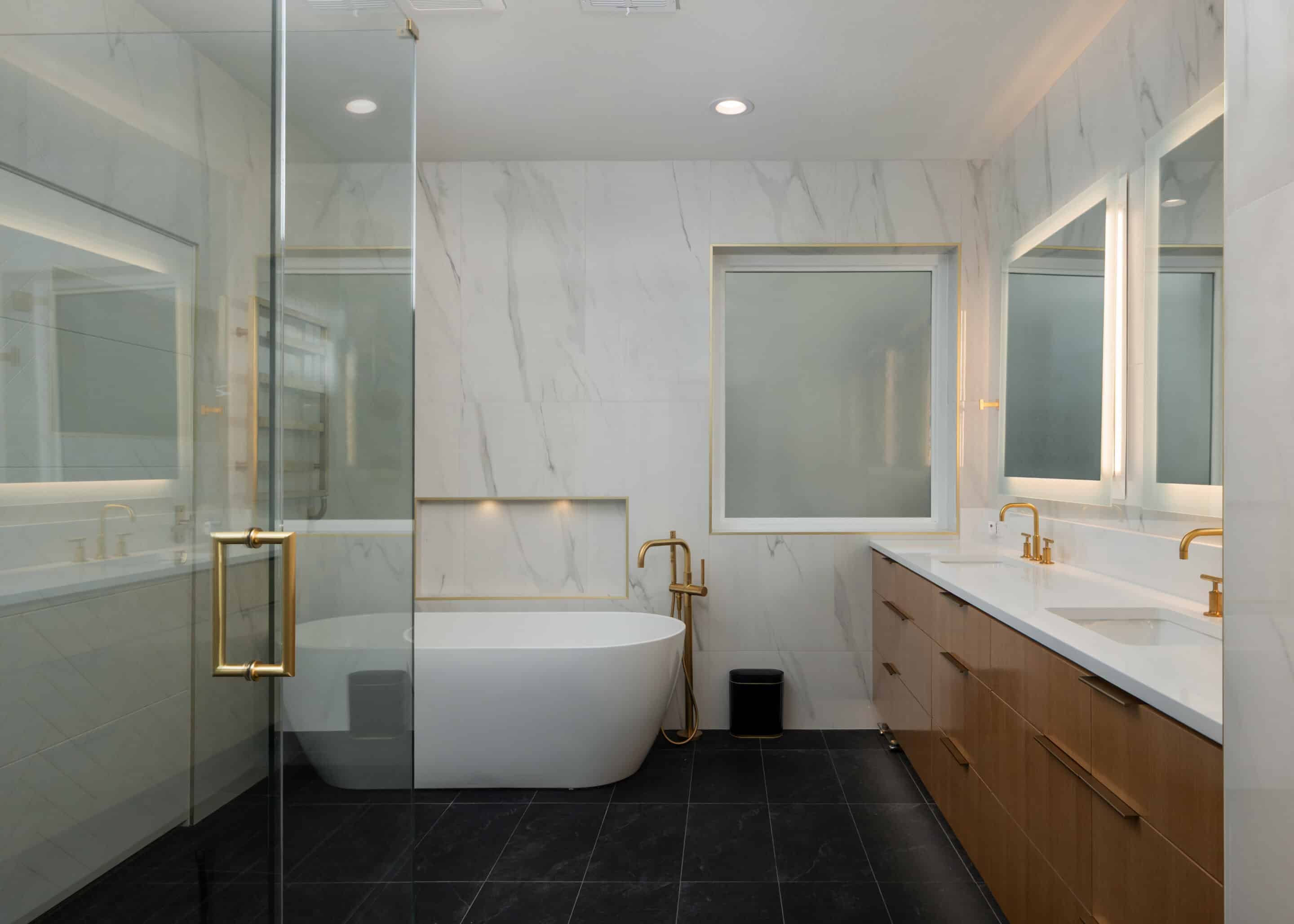
Use it wisely: spa bathrooms lean heavily on waterproofing and drainage done right — a curbless shower in particular has to be planned into the floor structure, not added on afterward. This is not a surface-level update; it’s a project where the parts you can’t see matter as much as the tile you can. Plan it as a real remodel, not a refresh.
5. Universal Design, Done Invisibly
More homeowners are planning to stay in their homes for the long haul, and they want spaces that will work at every stage of life without ever looking institutional. That’s the heart of universal design in 2026: curbless showers, wider doorways, comfort-height counters, lever handles, and lighting that’s genuinely easy to see by — all designed so beautifully you’d never call them “accessibility features.”
The shift is that these choices are no longer just for older homeowners. Younger families are asking for them too, because they make a home more comfortable and more livable for everyone: a curbless shower is easier to clean, a wider doorway makes moving furniture simpler, better lighting helps at any age. This is an area our team cares about deeply — we include NARI Certified Universal Design Professionals, so we design for how you’ll actually live in a space over decades, not just how it photographs on move-in day.
Use it wisely: the best time to build in universal design is during a remodel you’re already doing, because the structural pieces (shower thresholds, door widths, blocking in walls for future grab bars) are far easier and cheaper to handle now than to retrofit later. Even if you don’t need every feature today, planning for them costs almost nothing during construction.
6. Whole-Home Cohesion
Rather than remodeling one room in isolation, more Austin homeowners are thinking about the whole home at once — or at least planning individual projects so they add up to a coherent whole. The goal is a shared material and color story across the kitchen, living, and dining spaces so the home feels designed rather than assembled piece by piece over the years.
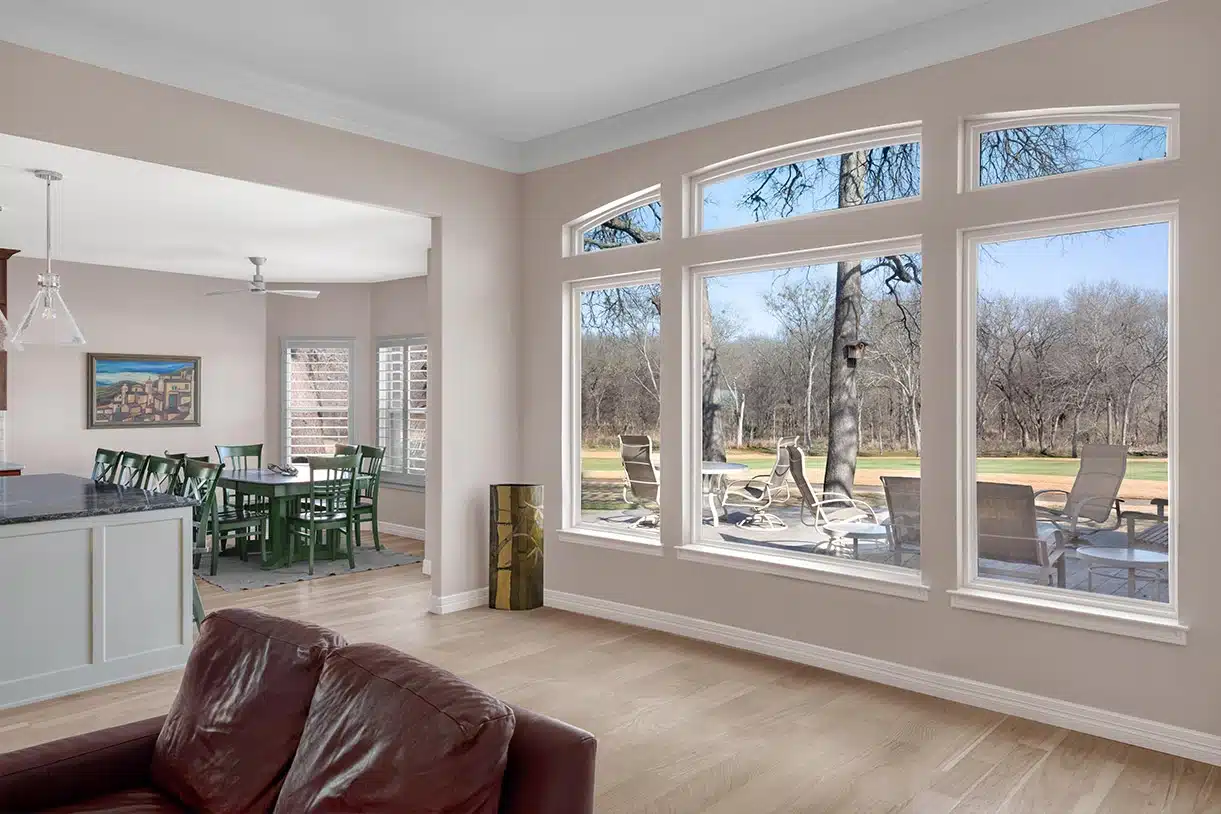
At the same time, the wide-open floor plan is being refined. Instead of one cavernous great room, homeowners want “open but defined” spaces — zones that flow together visually while still feeling like distinct rooms, achieved through things like ceiling details, partial walls, cased openings, and changes in flooring or lighting. It’s the middle ground between the closed-off rooms of older homes and the echoey open plans of the 2010s.
Use it wisely: even if you’re remodeling one room at a time for budget reasons, a whole-home design plan up front keeps every project pulling in the same direction, so you don’t end up with a beautiful new kitchen that clashes with the bathroom you do two years later.
7. Sustainable, Low-Tox Materials
Homeowners are asking harder questions about what actually goes into their homes. In 2026, that means zero-VOC paints and finishes, responsibly sourced woods, and durable materials chosen specifically so they won’t need replacing in five years. Part of the motivation is environmental; part of it is simply healthier indoor air and a longer-lasting remodel.
There’s also a growing preference for materials that age well rather than wear out — solid wood over veneer where it counts, natural stone that patinas, quality hardware that won’t loosen. Sustainability and longevity turn out to be the same conversation: the greenest remodel is often the one you don’t have to redo.
Use it wisely: ask your remodeler specifically about paint and finish VOC levels, where wood is sourced, and how the materials they recommend hold up over time. A team that can answer those questions clearly is one that’s thought about more than just the surface.
The Bottom Line on 2026 Home Renovation Trends
The thread running through every one of these home renovation trends is the same: warmth, longevity, and spaces designed around how people actually live — not how they look for a single photo. Trends are a starting point, not a rulebook. The best remodel blends what’s current with choices that will still feel right in ten years, tailored to your home and your life. See how these ideas come together in our portfolio of Austin projects.
Planning a remodel in 2026? Tell us what you have in mind and we’ll take it from there. Get Started
Frequently Asked Questions
What are the biggest home renovation trends in 2026?
Warm, earthy palettes replacing gray; larger kitchen islands with panel-ready appliances; mixed natural and engineered stone; spa-style bathrooms and wet rooms; invisible universal design; whole-home cohesion; and sustainable, low-tox materials.
What kitchen trends are popular in Austin right now?
Bigger islands with seating and a second prep sink, integrated and panel-ready appliances, warm and natural tones instead of cool grays, and mixed metal finishes like brass paired with matte black.
Are gray kitchens still in style in 2026?
They’re fading. Homeowners are moving toward warmer whites, greige, and natural wood tones for a more timeless, inviting look. Gray still works as an accent, but it’s no longer the default.
Do I have to follow trends when I remodel?
No. Trends are a useful starting point, but the best remodel reflects your home and how you live in it. A good design-build team helps you blend current ideas with choices that will still feel right in ten years — and steers your budget toward the permanent elements, not the ones that date quickly.
More Posts
7 Must-Haves for Your Austin Home Remodel
7 Must-Haves for Your Austin Home Remodel Written By Roy Faust Born and raised in Austin, Texas, I graduated from Lamar University with a Bachelor’s…
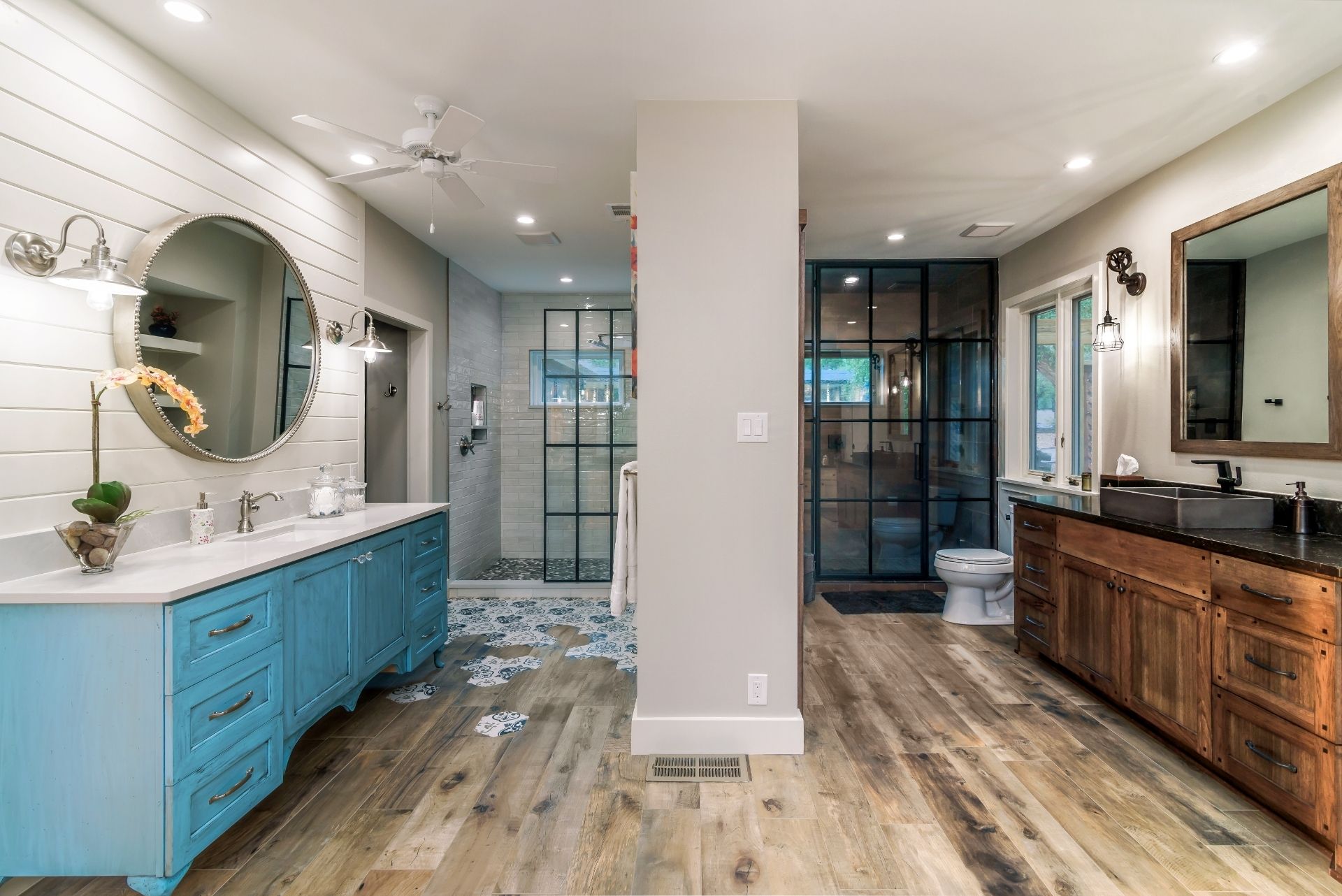
Master Bathroom Remodel Cost: What Choices Drive It?
Master Bathroom Remodel Cost: What Choices Drive It? Written By Roy Faust Born and raised in Austin, Texas, I graduated from Lamar University with a…
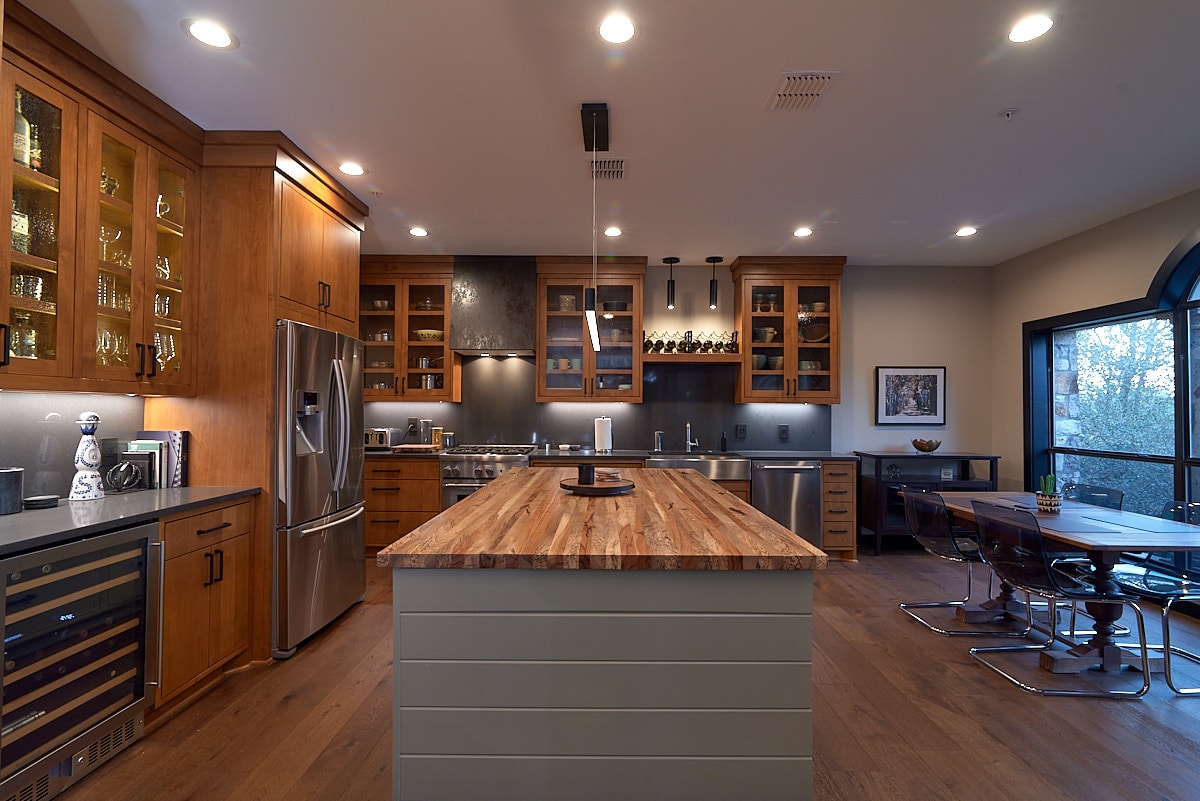
How to Find the Best Home Remodeling Contractor
How to Find the Best Home Remodeling Contractor Written By Roy Faust Born and raised in Austin, Texas, I graduated from Lamar University with a…